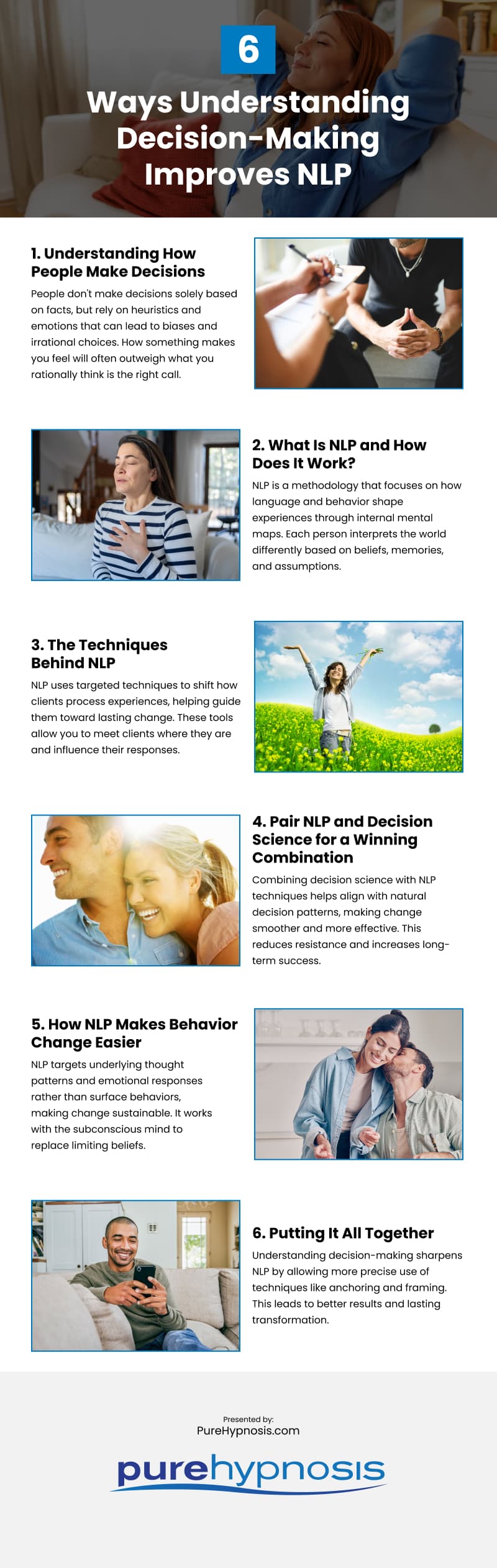
Whether you’re new to the field of Neuro-linguistic Programming (NLP) or looking to deepen your skills through an NLP certification, understanding how people actually make decisions is what separates a good practitioner from a great one. Emotions, unconscious biases, and mental shortcuts play a far greater role in decision-making than logic ever does. By pairing NLP with behavioral economics, you get an approach that aligns with how the mind naturally operates, making your coaching or therapy more effective.
Understanding How People Make Decisions
People don’t make decisions solely based on cold, hard facts. Rather, decisions are more often driven by mental shortcuts or “heuristics.” Heuristics are simple rules of thumb that your mind uses to make quick choices without overthinking. These shortcuts can be helpful, but they also lead to biases and irrational decisions.
For example, when you hear that a product is “popular,” you might automatically assume it’s good even without knowing much about it. That’s called the bandwagon effect, one of many cognitive biases that influence your choices.
Emotions play an equally powerful role. How something makes you feel will often outweigh what you rationally think is the right call.
What Is NLP and How Does It Work?
Many people have heard of NLP being used in conjunction with hypnosis to help people achieve certain goals in their lives. NLP is a methodology that focuses on how language and behavior shape experiences. Originally developed in the 1970s by Richard Bandler and John Grinder, NLP was built on the idea of understanding the connection between your thoughts, words, and actions.
At its core, NLP holds that subjective experiences (the way you interpret and respond to the world) are shaped by internal mental maps. Two people can experience the same event and walk away with completely different takeaways, because each person filters information through their own beliefs, memories, and assumptions. NLP hypnosis aims to identify and reshape those filters.
The Techniques Behind NLP
NLP uses a set of targeted techniques that are designed to shift how your clients process and respond to their experiences. Understanding how these tools work gives you a practical edge, allowing you to meet your clients where they are and guide them toward meaningful, lasting change.
Anchoring
This technique involves associating an emotional or mental state with a particular stimulus or trigger. The trigger can be almost anything, from a specific touch to a gesture, sound, or mental image. Once that association is established, the trigger can help clients bring that emotional state back to the surface.
For example, if someone feels confident and calm every time they hear a particular phrase or see a specific gesture, you can use that anchor to help them access that positive state whenever they need it. In hypnosis NLP, you might use this technique to reinforce desired behaviors, helping your clients feel empowered and motivated.
Anchoring can be especially useful for clients who struggle with performance anxiety or self-doubt. Rather than waiting for confidence or calmness to spontaneously appear, anchoring can help you give clients a reliable, repeatable way to call on the desired mental state when they need it most.
Framing
Framing is about presenting information in a way that influences decisions. The facts of a situation may not change, but the way those facts are framed can completely alter how someone feels about them.
In practice, this might look like helping a client reframe a career setback, not as a failure but as valuable data that points them toward a better path. Framing might also look like helping someone view an overwhelming task as a series of small, manageable wins rather than one intimidating leap.
Used skillfully, framing helps your clients break free from the grip of unhelpful narratives so they can approach their choices with greater confidence.
Pair NLP and Decision Science for a Winning Combination
When you pair decision science with NLP techniques like anchoring and framing, you create a more powerful and effective approach to change. Rather than asking clients to fight against their own decision-making patterns, you can tailor your NLP techniques to resonate with them on a deeper, more subconscious level. This not only increases the chances of success but also makes the transformation process smoother and more lasting.
For example, if your client has a goal to become more confident in social situations, using NLP alongside decision science techniques like anchoring and priming can help them build the emotional resilience and mindset needed to follow through with the change. The result? They’ll be able to adopt the behaviors they want, without the internal resistance that often arises when they try to fight their natural decision-making patterns.
How NLP Makes Behavior Change Easier
NLP works because it targets the root of behavior rather than the behavior itself. Instead of addressing surface-level habits, it creates shifts in the thought patterns and emotional responses that drive those habits in the first place. This is what makes change feel sustainable rather than forced.
Consider someone who struggles with public speaking. NLP can target the emotional barriers behind the anxiety, while decision science can help you work with your client’s natural thought patterns rather than against them. Pair them together, and you can guide your client from avoidance to confidence.
Much of this works through the subconscious mind, which drives a significant portion of your clients’ automatic behaviors and decisions. Through NLP, you can help clients surface limiting beliefs and unhelpful mental patterns. Paired with an understanding of how the brain naturally makes decisions, you can replace those patterns with ones that align with your client’s goals, making new behaviors far more likely to take hold and last.
Putting It All Together
Understanding how people make decisions doesn’t just add context to your NLP practice. It sharpens it. When you know what drives your clients’ choices at a subconscious level, you can apply anchoring, framing, and other techniques with greater intention and better results.
Whether you work as a coach or therapist, integrating decision science into your approach allows you to meet clients where they are, reduce resistance, and guide them toward change that actually lasts. NLP is already a powerful tool on its own. Paired with an understanding of how the mind decides, it becomes something far more precise and far more effective.
Video
Infographic
Understanding how people make decisions is essential for effective Neuro‑Linguistic Programming, especially for those pursuing advanced training or NLP certification. This infographic shows how mastering decision‑making patterns can enhance NLP practice.