
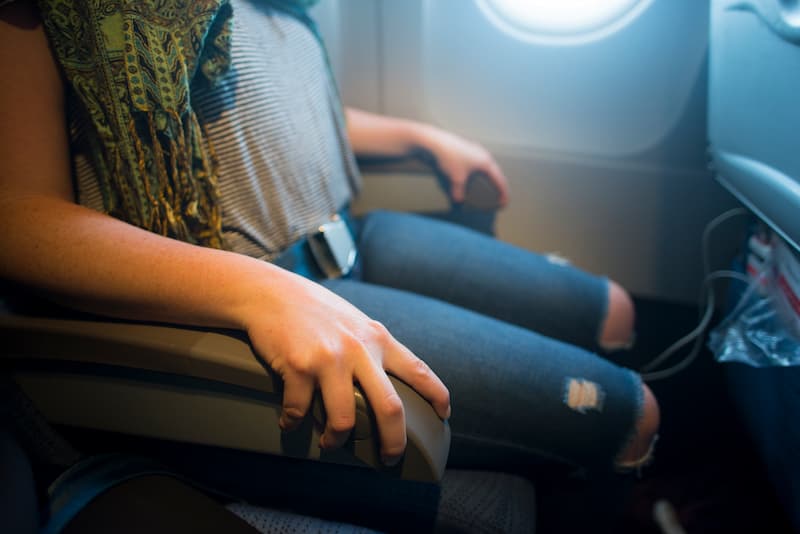
For millions of people, flying is a terrifying experience. You may feel fine while you’re sitting at your gate waiting to board. But the moment the cabin doors close and the engines power up for takeoff, your mind shifts into high alert. As fear and anxiety begin bubbling up inside you, your heart begins to race, and your palms grow sweaty in anticipation of what’s to come.
Flying fears are quite common and usually have little to do with the plane itself. The real source is what your brain has learned to associate with the experience. While efforts like rational self-talk and anxiety medications may help you cope in the moment, hypnosis for fear of flying offers another approach. Rather than simply managing your anxiety, it addresses your flying fears at a subconscious level.
Why Planes Trigger Your Brain’s Alarm System
Your brain is wired to protect you. It does this by constantly scanning for anything that looks, sounds, or feels like a threat. When it detects one, it activates a stress response, whether that’s a spike in heart rate or shallow breathing. Whatever the response, you feel it all as panic.
Over time, your brain learns to associate flying with discomfort or uncertainty. A rough flight, repeated exposure to stories about aviation accidents, or anxiety related to enclosed spaces, may be enough to teach your nervous system that airplanes are something to be wary of. Once that belief takes hold, it’s hard to uproot.
As a result, ordinary aspects of air travel can begin to trigger an outsized reaction. Your mind may interpret engine noise, turbulence, the sensation of takeoff, and even sitting in a closed cabin as warning signs. Your brain isn’t evaluating the actual level of danger in those moments. It’s responding to a pattern.
Facts and reassurance only go so far. You may already know the reality and statistics of safe air travel. But the problem isn’t reasoning or data. It’s the pattern your nervous system has built around the experience.
How Hypnosis Rewrites the Fear-Based Association
You’ve likely developed flight anxiety by associating the sights, sounds, and sensations of flying with danger. Hypnotherapy creates an opportunity to revisit those associations while your nervous system is calm and receptive.
Many hypnotherapists incorporate Neuro-linguistic Programming (NLP) techniques as part of that process. By working at the subconscious level, these techniques can help shift how your mind responds to your flying triggers.
Reframing
Reframing is an NLP technique that helps your brain assign a different meaning to familiar experiences. Instead of interpreting turbulence or the sound of the seatbelt sign turning on as a warning sign, a hypnotherapist can help you recognize it as a normal part of air travel. The event itself stays the same. What your brain makes of it begins to shift.
Anchoring
Anchoring, another NLP technique, can help reinforce feelings of calm and control. During hypnosis, an NLP hypnotherapist may help you associate a relaxed state with a simple physical cue, such as placing your hand over your heart or pressing your thumb and index finger together. Over time, that cue can become a reminder of the calm state you practiced during your sessions, making it easier to access while traveling.
Direct Suggestion
Some hypnotherapists use direct suggestion to strengthen new patterns of thinking and responding. While you’re in a deeply focused state, they may introduce suggestions designed to replace fear-based expectations with calmer, more helpful ones. Examples include statements like:
- “You feel calm and comfortable as the plane takes off.”
- “Turbulence is simply a normal part of flying.”
- “You remain relaxed and in control throughout the flight.”
- “Each stage of air travel feels easier than before.”
- “Your mind and body know how to stay calm while flying.”
Over time, these suggestions can help support new patterns of thinking and responding when flight-related triggers arise.
The Swish Method
Flight anxiety is often fueled by mental images that appear automatically. You may picture severe turbulence or find yourself rehearsing worst-case scenarios before the flight has even begun. Those images can intensify the fear response long before you get to your gate.
The Swish Method is an NLP technique that helps change that pattern. During hypnosis, your hypnotherapist may guide you to replace fear-based imagery with a picture of yourself remaining calm, comfortable, and confident throughout the flight. As your mind repeatedly rehearses that new image, the old fear response can begin to weaken, making it easier to approach flying with greater ease.
Reclaiming a Sense of Control in the Air
A big part of what makes flying frightening is the loss of control. You can’t steer the plane, you can’t see what’s ahead, and you can’t pull over. For a brain already running a threat response, that helplessness amplifies everything.
Hypnotherapy helps restore an internal sense of control. You may not be able to control the plane, but you can learn to manage your own internal state in response to what the plane does. That shift helps you move from feeling at the mercy of your fear to feeling capable of influencing your own response.
With consistent work, hypnotherapy can help you feel like flying is something you can handle rather than something you need to dread. Now, instead of spending every flight managing fear, you can devote more attention to the trip itself and the experiences waiting for you on the other side.