Many people’s first thoughts of hypnosis involve swinging pocket watches or a dramatic stage show. Clinical hypnotherapy is none of those things. It’s a calm, structured process that helps you access and shift the subconscious patterns behind your thoughts, habits, emotions, and stress responses.
Those patterns quietly drive more health issues than most people expect. Stress, chronic fear, disrupted sleep, and deeply ingrained behaviors can all make symptoms harder to manage. Regular hypnotherapy sessions work by settling the mind, reducing internal pressure, and interrupting the cycles that keep certain conditions stuck.
Hypnotherapy is not a replacement for medical care. It’s a complement to it. Used alongside the right treatment plan, it provides an additional layer of support that works with your nervous system rather than around it.
1. Stress and Anxiety
Stress and anxiety sit underneath a surprising number of physical and emotional symptoms. When your mind stays on high alert, your body tends to follow. You may notice muscle tension, shallow breathing, digestive trouble, restless sleep, irritability, or constant mental noise, often several of these at once.
Hypnotherapy for anxiety slows that internal overdrive. In a deeply relaxed state, your brain becomes more open to calmer suggestions and healthier emotional patterns. Reacting to stressors without spiraling starts to feel more like a realistic option rather than a constant daily struggle.
Racing thoughts at night, dread before appointments, or the persistent sense that your body never fully settles down are all signs that your nervous system is running hot. Hypnotherapy can help reset that baseline, giving your mind a different starting point when stressors show up.
2. Chronic Pain
Chronic pain wears you down mentally as much as physically. After months or years of discomfort, your nervous system can get locked in a reactive loop. You brace for pain, your mind anticipates it, and the whole experience grows heavier than the physical sensation alone would suggest.
Hypnotherapy can soften that loop. It supports pain management by reducing tension, calming the fear that builds around symptoms, and altering how your brain processes discomfort. Other forms of care may still be needed, but your relationship with pain can shift in a meaningful way.
3. Sleep Disorders
Sleep problems tend to build on themselves. One rough night spirals into fears about the next one. Bedtime starts feeling tense, and you learn to associate sleep with frustration. That pattern makes insomnia much harder to break on its own because your anxiety around sleep becomes its own barrier.
Hypnotherapy calms the mental and physical state that keeps sleep out of reach. It can reduce your bedtime anxiety, quiet your racing thoughts, and help your mind reconnect with rest rather than struggle. Over time, that shift can improve both sleep quality and your overall confidence around sleep.
When sleep issues stem from stress, this connection becomes even more important. Hypnotherapy works by settling your nervous system first. The calmer you become, the easier it is for your body to do what it already knows how to do.
4. Digestive Issues
The digestive system responds strongly to stress. Bloating, cramping, nausea, or general discomfort often flares up during stressful periods, even when food isn’t the main culprit. Your gut and nervous system are constantly communicating, and that link is far deeper in your subconscious than you may realize.
Hypnotherapy lowers that background stress load. A hypnotherapy practitioner can help you shift your nervous system into a calmer state, which can help your digestive system have a better chance of working more smoothly. This is especially relevant when your symptoms ramp up around anxiety, pressure, or emotional strain rather than specific foods or dietary habits.
Hypnosis can also interrupt the cycle in which your digestive discomfort creates more worry, which in turn creates more digestive discomfort. Breaking that loop gives you a chance to step off the rollercoaster and find some consistency in how you feel day to day.
5. Addictions and Compulsive Habits
Many addictive patterns run on subconscious loops. You experience a trigger, then suddenly a craving kicks in, and your mind runs the same response. Smoking, alcohol, food, nail biting, hair pulling, and other automatic habits all share this pattern. You’ve repeated the behavior so many times that it operates largely on autopilot.
Hypnotherapy works well here because it reaches beneath the behavior itself. Two Neuro-linguistic Programming (NLP) techniques commonly used in hypnotherapy sessions are reframing and anchoring, and both can meaningfully reduce the emotional charge around your triggers.
Reframing
When a trigger hits, the story you tell yourself about it shapes how strongly you react. Reframing helps you interrupt that story and replace it with a more balanced interpretation. Working with a clinical hypnotherapist, you can train the logical part of your brain to take the lead, dialing down the fear and stress response that usually drives the craving.
Anchoring
Anchoring gives you a portable tool to carry into everyday life. By pairing a physical gesture with a positive emotional state during hypnotherapy, you build a reliable cue you can call on when cravings surface. Because your brain is more open to forming new patterns during hypnosis, that connection tends to be stronger and more lasting than habits built through willpower alone.
Together, these approaches can shift the internal story that keeps you relying on your addiction or bad habit.
6. Obesity
Weight struggles usually involve more than food choices. Stress eating, emotional eating, poor sleep, and automatic comfort-seeking all shape the pattern. Knowing what to do but feeling pulled toward the opposite is often a sign that your subconscious habits are running the show, not that you lack willpower or motivation.
Hypnotherapy supports weight management by calming those deeper drivers. It can help you learn to pause before reacting or find more control when you experience a craving. As your relationship with food steadies over time, your body awareness can improve, and the emotional urgency that often fuels overeating can start to ease.
7. Fears and Phobias
Phobias can feel completely irrational and still be very real. You might know logically that a plane, a needle, or a crowded elevator isn’t dangerous, but your body reacts as if the threat is immediate. That’s because fear often lives at the subconscious level, well below the reach of rational thought.
One NLP technique used in clinical hypnotherapy is the Swish Method, which teaches your brain to replace a threatening mental image with a neutral or positive one. Over time, this can help reduce phobias that have persisted for years. The process calms your nervous system and rewires the associations you’ve built around the feared object or situation.
You might be seeking relief from a fear of flying, driving, public speaking, needles, or medical procedures. Through hypnotherapy, you can learn to gradually reenter the everyday experiences that once felt completely off limits.
More Than a Surface Fix
Lasting change rarely comes from understanding a problem alone. If it did, knowing you were stressed, sleep-deprived, or caught in a habit loop would be enough to fix it. The subconscious doesn’t work that way, and neither does healing.
Hypnotherapy works at the level where your patterns actually live. It’s not a shortcut or a standalone solution, but used alongside the right care, it gives you access to a part of yourself that most treatments never reach. For the health issues covered here, that kind of deeper work can make all the difference in how far your recovery actually goes.
Video

Infographic
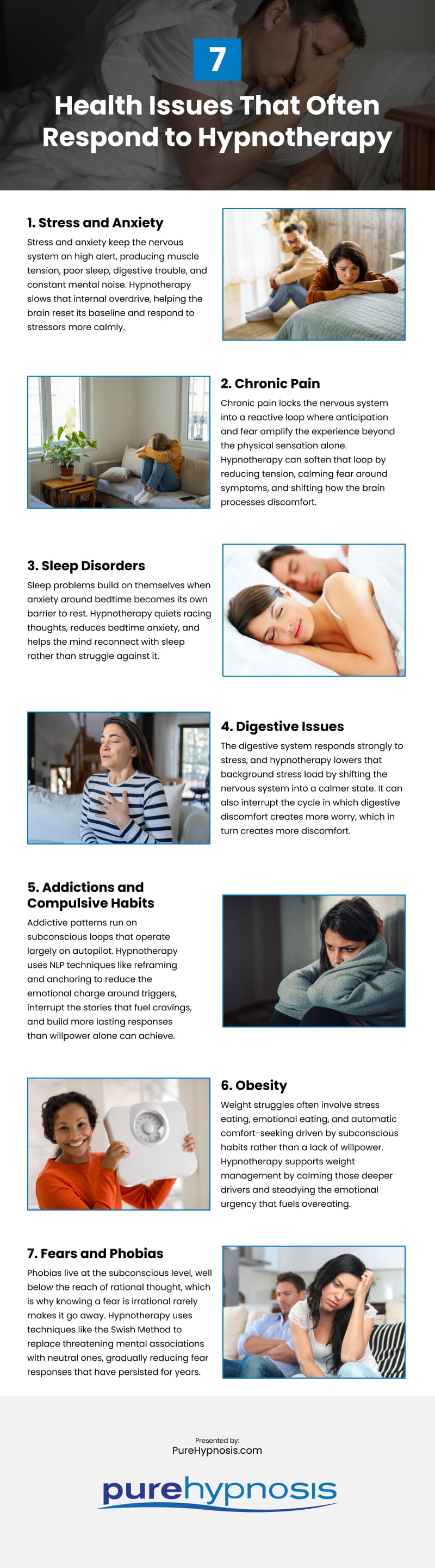
Clinical hypnotherapy supports a wide range of health conditions by working with the subconscious mind to calm the nervous system, shift deep-rooted patterns, and reduce emotional drivers behind stress, pain, and fear. Find out the health issues that often respond to hypnotherapy in this infographic.