

Your relationship with a toxic individual ended months ago. Apparently, your body didn’t get the memo.
A mutual friend mentions their name at dinner, and your stomach drops before you’ve even registered why. Someone posts an old photo, and suddenly you’re anxious or strangely numb for the rest of the day.
If the relationship left you constantly managing someone else’s moods, that reactivity often runs deeper than it would after an ordinary breakup.
This is one of the most common reasons people look into hypnosis to get over someone. They want to pull their emotions together and move on. But their nervous system is still busy doing two separate jobs: grieving the loss of the person and coming down from the constant tension of bracing for the next blow-up. The second job is usually the slower one.
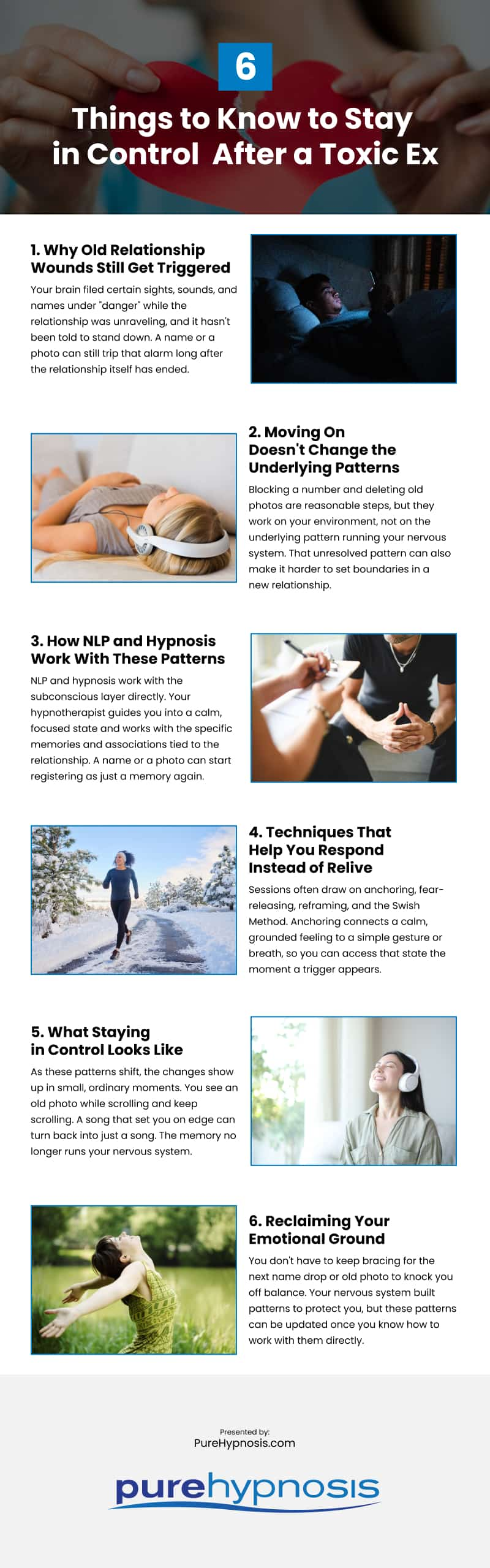
Why Old Relationship Wounds Still Get Triggered
A study measuring brain activity found that images connected to a breakup, including photos of an ex-partner, produced heightened activity in the hippocampus and amygdala, the same regions involved in processing genuine threat.1 For some participants, that activation looked similar to what shows up in response to other seriously distressing events.
In your past relationship, your brain filed certain sights, sounds, and names under “danger” while the relationship was unraveling, and it hasn’t been told to stand down. A name or a photo can still trip that alarm long after the relationship itself has ended, especially if it involved things like betrayal, unpredictability, and gaslighting.
This may explain why the reaction so often feels disproportionate to what triggered it. You’re not overreacting to a text from a mutual friend. You’re reacting to what your nervous system associated with that name months or years ago, and that association hasn’t been updated to reflect the new reality.
Moving On Doesn’t Change the Underlying Patterns
Blocking a number and deleting old photos are reasonable steps. But those steps work on your environment, not on the underlying pattern that’s running your nervous system. Sure, you took physical steps to move forward, but your response underneath them never got addressed, so it stayed exactly where it was, waiting for the next reminder to surface.
That same unresolved pattern can also make it harder to set boundaries in a new relationship, since a nervous system still bracing from the last one has a hard time trusting that a new situation is actually safe.
How NLP and Hypnosis Work With These Patterns
Neuro-linguistic programming (NLP) and hypnosis work with the subconscious layer directly, rather than only managing your environment or talking you through the reaction after it starts.
During a session, your hypnotherapist guides you into a calm, focused state and works directly with the specific memories and associations tied to the relationship, rather than applying a generic script to “relationships” as a category. Sessions are shaped around what actually happened between you and this specific person, since the pattern left behind by a breakup with a controlling ex looks different from the pattern left behind by a more amicable breakup.
What changes is how your body and mind respond the next time something reminds you of what happened. A name or a photo can stop functioning as a trigger and start registering as just a memory again. Most of that work happens in the session itself, but you’ll typically leave with an audio recording built around your specific triggers, meant to reinforce the new response before the next reminder catches you off guard.
Techniques That Help You Respond Instead of Relive
Sessions built around relationship pain often draw on a few specific NLP techniques:
- Anchoring: Connects a calm, grounded feeling to a simple gesture or breath. This way, you can access that state the moment a trigger appears, whether that’s running into one of your ex’s friends or visiting a place you used to go together.
- Fear-releasing: Helps you face and work through the specific fears tied to the relationship, rather than avoiding them and hoping they fade on their own.
- Reframing: Helps you interpret the relationship and what it meant about you differently, so old moments carry less emotional charge when they resurface.
- The Swish Method: Replaces the automatic reaction to a trigger, like seeing an old photo or hearing their name, with a new empowering response, so your brain starts running a different picture instead of the old one.
Between these, fear-releasing tends to help most with triggers that surface as anxiety or emotional shutdown. That’s because it addresses the underlying fear directly instead of asking you to just tolerate it whenever it shows up. The anchor, by contrast, works best in the exact moment a trigger actually appears. It gives you something practiced and calm to reach for instead of the old automatic reaction, whether that reaction was anger, panic, or going quiet.
What Staying in Control Looks Like
As these patterns shift, the changes tend to show up in small, ordinary moments rather than dramatic ones. A mutual friend brings up their name, and you can respond normally instead of leaving the conversation early. You see an old photo while scrolling and keep scrolling, instead of losing the next hour to it.
You might run into your ex in person and notice you’re simply present for the interaction, without your heart rate spiking or your mind going blank. A holiday or an anniversary that used to be automatically ruined by their absence starts to feel like just another day again. Even a song that set you on edge can turn back into just a song.
None of this means the relationship has been erased from your mind. It means the memory of it no longer runs your nervous system.
Reclaiming Your Emotional Ground
You don’t have to keep bracing for the next name drop or old photo to knock you off balance. Your nervous system built patterns to protect you, but these patterns can be updated once you know how to work with them directly instead of just managing your way around them.
Contact Pure Hypnosis about our services for getting over a difficult relationship. Ask about our flexible hypnosis scheduling, including evenings and weekends.
Video
Infographic
1https://www.sciencedirect.com/science/article/pii/S0165032724006645