You know when your confidence is lacking. When it’s solid, you make decisions without second-guessing yourself and can follow through on commitments without issue. But when it’s shaky, even small challenges can feel larger than life.
Confidence isn’t primarily a mindset. It’s a subconscious state. The internal voice that tells you you’re not good enough or will completely fail isn’t coming from your reasoning mind. It runs deeper, in the beliefs and associations your brain built long before you had much say in the matter.
In some cases, approaches like confidence and self-esteem hypnosis can help uncover how these deeper beliefs may be shaping your behavior. Understanding those patterns can be a first step toward building lasting confidence.
Where Confidence Really Breaks Down
Most advice about confidence focuses on behavior. Speak up more. Fake it until you make it. Push through the fear. These strategies can help in the moment, but they rarely touch the underlying pattern. That’s because confidence isn’t something that sits at the surface level.
Self-doubt, perfectionism, and the influence of past experiences all operate below conscious awareness. A failed presentation years ago can still subtly shape how you approach public speaking today. A message you absorbed in childhood about not being smart or capable enough can quietly undermine how you advocate for yourself in adulthood. None of these patterns is logical, but they’re real, and they’re persistent.
The critical mind, the part of you that filters and evaluates information, often reinforces existing beliefs rather than challenging them. If self-doubt is the established belief, your mind will find evidence for it everywhere.
Over time, this problem compounds. The more often self-doubt shapes your choices, the more it begins to define how you see yourself.
How Confidence Self-Esteem Hypnosis Works
If you’re searching for “hypnosis near me,” it helps to understand what happens during a session and how the process can affect your confidence at a deep level.
During a session, a hypnotherapist guides you into the theta state, a deeply focused and relaxed mental state similar to being on the edge of sleep. It’s here that your subconscious becomes more receptive, and new patterns can take hold in ways they can’t when your mind is fully alert.
Some sessions may also incorporate Neuro-linguistic programming (NLP) techniques alongside hypnosis to address the specific structure of your insecurity. NLP is a framework that focuses on how your thoughts and internal language shape your emotional response and behavior. Here are a few NLP techniques a hypnotist may use in a confidence or self-esteem-focused session:
Reframing
Sometimes a single bad experience can shape how you see yourself for years. Maybe you said the wrong thing in an important conversation, and your mind stored that as proof that you are not confident. Reframing works by changing how you interpret that experience, helping you see it as a moment of learning rather than evidence of failure.
Anchoring
Anchoring creates a way to reconnect with a confident emotional state when you need it. In session, a hypnotist might guide you to recall a time when you felt capable or fully in control, and then connect that feeling to a physical cue, such as pressing your fingers together. With repetition, that cue can help you return to that state before a stressful conversation or decision.
The Swish Pattern
The swish pattern is used to break the mental habit of expecting yourself to fail. If you automatically picture yourself stumbling over your words, that image can trigger anxiety before anything even happens. This technique helps replace that automatic image with one where you see yourself staying calm and handling the moment well. Over time, that more confident response can begin to feel more natural.
Who Can Benefit From Self-Esteem and Confidence Hypnosis
You may benefit from self-esteem and confidence hypnosis if you are:
- An executive or leader who struggles with second-guessing or making decisions under pressure.
- An athlete who wants to stay focused and perform with more consistency.
- An entrepreneur navigating uncertainty, risk, and the pressure of making high-stakes decisions.
- A public speaker or performer who feels anxious or overly self-aware in high-visibility moments.
- A professional stepping into a new role and adjusting to greater responsibility.
- Someone who tends to overthink or hold back in conversations or opportunities because you fear judgment or failure.
In many cases, self-esteem and confidence hypnosis helps you strengthen trust in the abilities you already have. As you make that internal shift, you can access it more easily in the moments you need it most.
The Ripple Effect of Confidence
The same change that transforms how you show up professionally tends to reach every other part of your life. More confidence can contribute to:
- Stronger relationships by helping you set healthier boundaries and express your needs with less fear of rejection or judgment.
- More consistency with personal habits by making it easier to follow through on commitments like exercise, sleep, or other goals without falling into cycles of starting and stopping.
- Greater emotional resilience by reducing the influence of self-doubt and helping you stay steadier when challenges come up.
- More personal growth by making it easier to take risks and pursue goals that once felt out of reach.
- A stronger sense of self-trust by building confidence in your ability to handle changes and setbacks.
Confidence That Holds When the Pressure Is On
One of the clearest differences between surface-level confidence and the kind built through hypnotherapy is durability. Motivation and self-talk can carry you on a good day, but they may not be there for you when the stakes are highest.
Confidence rooted in the subconscious is more reliable because it isn’t dependent on external circumstances. You don’t need to be winning to feel capable. You don’t need validation from other people to feel grounded. Your internal steadiness makes sustained high performance possible across different areas of life.
Self-esteem hypnosis moves well beyond surface-level strategies. You’re not just focusing on behavior; you’re focusing on where that behavior begins.
Video
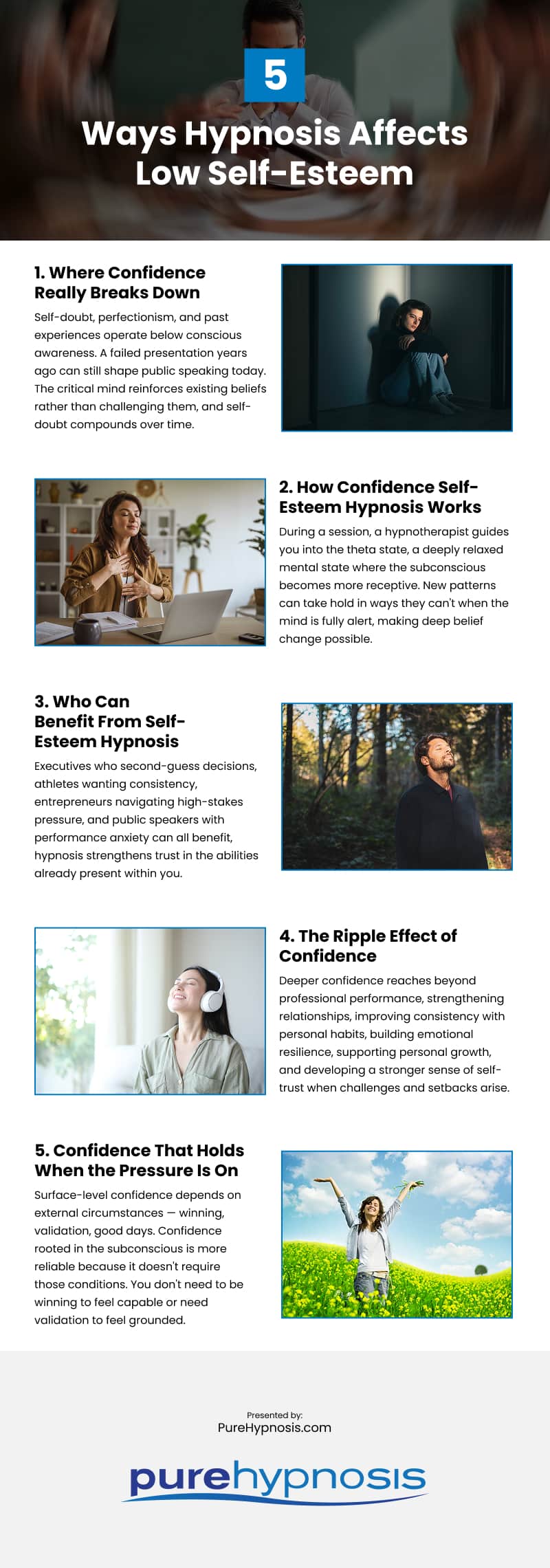
Infographic
Confidence isn’t primarily a mindset; it’s a subconscious state, and the self-doubt that undermines it runs deeper than surface-level strategies like positive thinking or pushing through fear can reach. Discover ways hypnosis affects low self-esteem in this infographic.