You notice a strange ache or pain. What could it be? As your concern mounts, you find yourself doom-scrolling medical articles on your phone.
But wait. You know this isn’t helping. You know it’s giving you the jitters and making you fear the worst. You exit out of your browser. You promise to stop the searching. But even still, you know you’ll be back…probably sooner than later.
Health anxiety pulls you into predictable mental loops. Even if they feel logical in the moment, they’re exhausting in hindsight. Hypnosis for health anxiety is one approach you could use to address this anxiety because it targets those loops at a subconscious level.
Why Scrolling Feels Like Help
Excessive internet searches are a natural response to uncertainty. Anxiety, at its core, is a reaction to perceived threat combined with a sense of having no control over that threat. Searching for information, even if it’s 2 a.m., feels like taking control. Subconsciously, your mind believes that searching promises an immediate answer, a way out of the discomfort, but searching rarely gives you the certainty you’re after.
Medical search results are written for populations, not individuals, and they can’t rule out the scenarios your anxious mind is already convinced are true. Any relief you find after reading a few medical abstracts quickly fades the moment you notice another symptom.
If you’re caught in a cycle of health anxiety, it’s important to understand what’s keeping you trapped. Here’s a closer look at these traps and how hypnotherapy can help you overcome them.
Trap 1: The Catastrophizing Spiral
Catastrophizing is the pattern of jumping from symptom to worst-case conclusion with minimal stops in between. You notice a headache and, within seconds, you’re convinced you have a brain tumor. You feel a twinge in your chest, and suddenly you believe you’re going to have a serious cardiac event. The conclusion your subconscious creates takes center stage before you’ve had time to consider context, timing, or any other explanation.
Catastrophizing is a learned pattern. It typically develops because you had past experiences where something unexpected turned out to be serious, or when uncertainty felt genuinely dangerous. Over time, your subconscious has become overly sensitive to physical signals and responds by generating worst-case scenarios to protect itself.
Hypnotists address this pattern at the subconscious level, where the worst-case leap actually originates. By guiding you into a calm, focused state, they can help you change how your mind interprets physical sensation, reducing the intensity of your subconscious’s response.
Now, instead of jumping straight to alarm, your mind can register the situation, pause, and fully consider what it might be without leaping to the worst-possible scenario.
Trap 2: The Reassurance Cycle
Health anxiety research produces a temporary sense of relief. You find the benign explanation, feel the tension ease, and tell yourself you’re fine. But that reassurance rarely lasts. An hour later, you’re suddenly worried about something else, you’ve noticed a new symptom, or you’re no longer sure you read the article correctly. So you search again.
This is the reassurance cycle, and it’s one of the more stubborn traps in health anxiety. Each search temporarily reduces your anxiety just enough to reinforce the behavior, which makes it harder to resist the next time. Over time, you need to search more to produce the same relief, and the relief lasts for less time.
Hypnosis interrupts this cycle by addressing, at the subconscious level, what you’re trying to accomplish through endless searching: fear management. When your fear response itself becomes less intense, the pull toward reassurance-seeking weakens. A hypnotherapist can help your subconscious lower the intensity of that fear response at its source, rather than leaving you to manage it moment-to-moment through searching.
Trap 3: The Control Illusion
At its root, health anxiety is a response to uncertainty. Your body does things you can’t fully explain, and the medical system is complex and imperfect. For some, that uncertainty becomes intolerable, and searching for answers becomes a way to feel like it’s being managed. But no amount of searching for an answer can eliminate the unpredictability of health.
A hypnotist can help you address your underlying relationship with uncertainty. Through techniques like neuro-linguistic programming (NLP), which looks at the connection between your thought patterns, behavior, and language, a hypnotherapist can work with the part of your mind that perceives uncertainty as dangerous, gradually helping it develop a more stable, less reactive response to not knowing.
For instance, your hypnotherapist may use reframing, an NLP technique, to help you see uncertainty as a normal, unavoidable part of health rather than a sign that something is wrong. Similarly, they could use parts integration, another NLP technique, to help you unify the part of your mind that seeks control with the part that can tolerate the unknown.
Trap 4: Avoidance Dressed as Research
This is the subtlest of the five traps, and the one you likely won’t immediately recognize. Health anxiety is uncomfortable. Sitting with physical fear, with the real possibility that something might be wrong, is genuinely unpleasant. Researching your symptoms keeps your mind occupied and focused on a task, which feels preferable to just feeling the anxiety directly.
Scrolling can function as emotional avoidance. It looks productive. It feels like you’re handling the problem. But it keeps you from experiencing and addressing the underlying fear, so the fear doesn’t diminish. It waits.
Hypnosis addresses avoidance at the level where it operates. Rather than pushing you to face anxiety through sheer willpower, a skilled hypnotherapist can guide your subconscious toward the fear in a state of calm and controlled focus. This can help you process that fear gradually, without the emotional flooding that avoidance is meant to keep at bay.
Trap 5: Hypervigilance After the Search
Once you’ve read about a condition, your brain knows what to look for. Now, you’re noticing sensations you would have ignored an hour ago, and interpreting them as evidence. Every throb or twitch feeds your bias. This hypervigilance can turn an ordinary physical experience into self-confirming data.
This is a learned sensitivity. If your nervous system is shaped by health anxiety, it’s been trained to stay on high alert, constantly monitoring for signals of danger. A hypnotist can use hypnosis to help you calm that alert state at the subconscious level, potentially reducing your nervous system’s overall reactivity and making your body feel safer.
For example, your hypnotherapist might guide you to notice a sensation you’d normally become hypervigilant over (such as a flutter in your chest), and simply observe it without judgment until it passes. This kind of hypnotic exercise can help your nervous system learn to treat sensations as neutral information rather than immediate threats.
Moving Past the Health Anxiety Loop
Health anxiety doesn’t care about reason. You can know, logically, that a headache is almost certainly not a brain tumor and still spend two hours searching page after page on Google for an answer anyway. That disconnect between what you know and how you respond exists because these patterns operate at the subconscious level, not the conscious one.
Because hypnosis works within that subconscious space, it can help you address these patterns where they take shape.
If you’re tired of letting your health anxiety pull you into exhausting information loops, hypnosis may be one option to consider. Search for “hypnosis therapy near me.” That’s one form of Googling that can lead you away from, not toward, health anxiety.
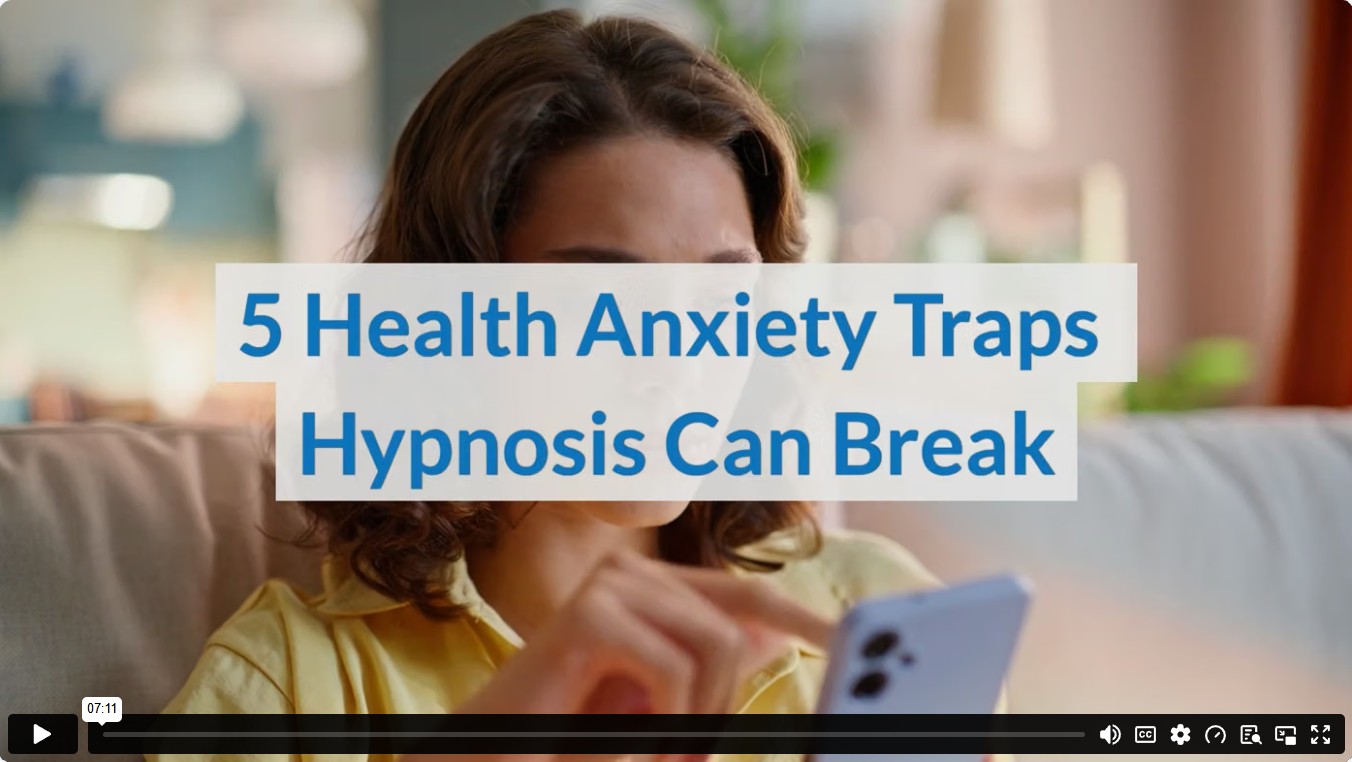
Video
Infographic
Health anxiety pulls people into predictable mental loops that feel logical in the moment but exhausting in hindsight, and hypnosis addresses them at the subconscious level where they begin. Check out the health anxiety traps hypnosis can break in this infographic.